
Broken telephone: Conservative MP Andrew Lawton takes poor cell coverage into his own hands

The Wire Report subscribers read this story first. Take a free trial to get exclusive coverage of Canada’s telecom and media sectors, and their interaction with the government.
Conservative MP Andrew Lawton knows first hand the challenges of living in an area with poor cell coverage.
It’s something the rookie MP regularly deals with in his southwestern Ontario riding. Lawton (Elgin—St. Thomas—London South, Ont.) could be driving from his St. Thomas, Ont., office to neighbouring communities like Sparta or Shedden, speaking with staff members or concerned constituents.
Then, all of a sudden, there’s nothing on the other end of the line.
“I’m someone who has spent a lot of time all over the riding,” Lawton said in an interview with The Wire Report. “And I’m not always able to reliably do my job.”
“I’ll be in these areas for hours for events or meetings and, in that time, I’ll have maybe a couple messages come through. And, people in these areas are … living this challenge every single day.”
Lawton, currently a client with Rogers Communications Inc., has also received a steady stream of coverage-related complaints at his constituency’s headquarters, prompting him to take action.
His idea? The Cellular Connectivity Project, a crowd-sourced initiative designed to identify cellular dead zones and build a more reliable coverage map.
Shortly after Lawton launched the forum on his website last month, he quickly discovered cellular challenges transcend communities and service providers.
“I thought this would appeal more to rural people,” said the Tory MP, who represents a largely agricultural riding south of London, Ont. “But I was actually shocked to find out how many issues these people are encountering very close to relatively major population centres, including parts of London (population 422,000) and St. Thomas (population 43,000).”
“This isn’t just a rural issue.”
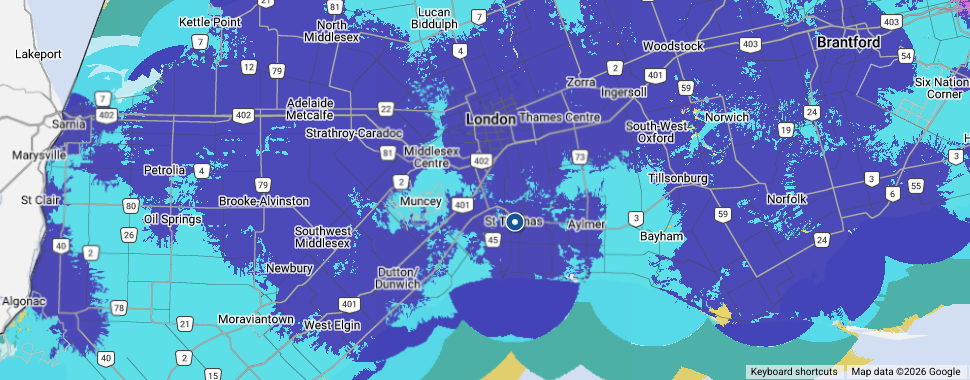
Through the Cellular Connectivity Project, Lawton will receive community input for two months and then send the aggregated data to the area’s primary service providers, Innovation, Science, and Economic Development Canada, and the Canadian Radio-television and Telecommunications Commission (CRTC).
He’s already received assurance from Rogers and BCE Inc.’s Bell Canada that both telecom giants will use the survey to help determine where tower repairs or additional builds may be needed, though neither responded to The Wire Report’s request for comment.
“I’m also having some conversations with third-party tower companies that have reached out as well,” he continued.
“I’m not interested in laying blame, but I am interested in getting results.”
Has the message reached the nation’s capital?
Cellular coverage gaps are increasingly becoming a point of discussion on Parliament Hill, with MPs and Senators raising local concerns related to access to emergency services and economic opportunities.
In recent months, a plethora of MPs from across party lines have sponsored citizen-led petitions advocating for better cell service in locales ranging from Barrington, N.S.; to Saint-Martin, Que.; to Amisk, Alta.
Conservative Leader Pierre Poilievre (Battle River-Crowfoot, Alta.) brought forward one such petition earlier this year, in which signatories raised concerns regarding the “significant reduction in cellular phone and data services experienced in [east central Alberta] for the past several months in addition to the generally limited coverage.”

Most petitions on the subject have received a boilerplate government response, approved by Industry Minister Mélanie Joly (Ahuntsic-Cartierville, Que.), touting Ottawa’s progress on the issue.
“In 2023, the government issued a binding policy direction to the CRTC, which included a direction for it to develop and implement a standardized and robust approach for reporting mobile coverage,” wrote Joly in response to Poilievre’s petition. “The CRTC has been progressively implementing the policy direction by translating it into their detailed rules.”
“The government looks forward to continuing to engage with Canadians and all levels of government to promote access to high-quality and reliable mobile services across the country.”
The CRTC, which did not immediately respond to The Wire Report’s request for comment, opened a proceeding into improving mobile coverage data earlier this year, though the regulator has yet to issue a decision on the matter.
CRTC data is based on reports submitted by telecom companies, like Rogers, Bell, and Telus Corp., and currently suggest 99.5 per cent of Canadian residents have access to mobile services.
However, the commission acknowledges “public opinion research shows that many Canadians still find that there are significant gaps in coverage.”
“The big problem is beyond the lack of coverage across the area,” said Lawton. “If you look at the coverage maps published by the telecom companies, you wouldn’t know there are any dead zones.”
“So, I wanted to do a one-two punch and get some more accurate information and push the telecom companies to provide more transparency in their maps, and then also work to plug some of those gaps.”

Liberal MP Marianne Dandurand (Compton–Stanstead, Que.) has also made improving coverage data a focal point through Bill C-268, her private member’s effort that would force the CRTC to establish a process to “ensure the accuracy of the mobile network coverage data that Canadian carriers … provide to the commission.”
“Nobody agrees with [supposed coverage rates], so why does the CRTC have this data?” Dandurand told The Wire Report back in March. “It’s because they ask cell phone companies about the coverage they provide, but there’s no parameters.”
“When we know what’s happening, it’s going to be easier to take action. So, I’m asking for the CRTC to have better data,” she said.
C-268 has been endorsed by Conservative, Bloc Québécois, and NDP MPs. It passed through second reading and was referred to the House Industry Committee before Parliament rose for its summer break.
Dandurand’s bill will be among the committee’s agenda items when MPs return to Ottawa later this month.
In the meantime, Lawton offered the blueprint for his Cellular Connectivity Project to any interested MPs, and expressed a desire for his parliamentary colleagues to join the fight.

“When I launched this project, I shared it with my colleagues in southwestern Ontario, and they’re all interested in doing something similar,” he said. “And I would be happy to share it with any other MP that wants to do this work… because I think it’s a national issue.”
“I’m working on the little slice of the country that I represent, but this is something that people are overwhelmingly experiencing. The more developed technology gets, the more reliant we are on it, and we haven’t yet had the capacity catch up with this.”
Lawton is also spearheading the development of the Conservative Party’s platform for the next election, which must take place by 2029, and he suggested the Tories could submit some new policy proposals.
“I will be pushing for the party to do more on this,” he said. “But it’s not a conversation I’m able to have just yet because the platform development is always an ongoing process.”
“So, I would just say to stay tuned.”
Davis Legree is the editor of The Wire Report, where this piece was first published. The Wire Report, owned by Hill Times Publishing, covers the intersection of business, technology, and government, with a special focus on the regulatory sphere. Sign up here for a free trial.
dlegree@thewirereport.ca
The Hill Times